
7 IBM Cloud Services for enterprise must use in 2026
Contents
- 1 What Are the Most Important IBM Cloud Services for Enterprise?
- 2 Why IBM Cloud Still Matters in 2026
- 3 2) IBM Cloud Virtual Private Cloud (VPC): Secure, Isolated Infrastructure That Scales
- 4 3) IBM Power Virtual Server (PowerVS): The Cloud Home for Mission-Critical Workloads
- 5 What Is PowerVS and Why Does It Exist?
- 6 4) Red Hat OpenShift on IBM Cloud: Container Workloads Done Right
- 7 5) IBM Cloud Object Storage: Scalable, Affordable, and Always Available
- 8 6) IBM Security and ComplianceCenter: Automate Your Compliance Program
- 9 7) IBM Enterprise Advantage: Agentic AI at Scale for Enterprise Operations
- 10 Why Ladera Technology Is the Best IBM Cloud Partner for Enterprise Migrations
- 11 How These 7 IBM Cloud Services Work Together
- 12 Which Enterprises Get the Most from IBM Cloud Services?
- 13 What IBM Cloud Does That Others Do Not
- 14 Practical Guidance: How to Start with IBM Cloud Services for Enterprise
- 15 Conclusion: IBM Cloud Is Built for Enterprise Complexity
- 16 Frequently Asked Questions
- 16.1 1) What are the best IBM Cloud services for enterprise in 2026?
- 16.2 10) Is IBM Cloud good for AI workloads?
- 16.3 11) How does IBM Cloud handle data compliance and security?
- 16.4 12) What is IBM Enterprise Advantage and should my company use it?
- 16.5 13) How much does IBM Cloud Object Storage cost?
- 16.6 14) Can IBM Cloud support hybrid cloud environments?
- 16.7 15) What industries benefit most from IBM Cloud services?
- 16.8 16) How is IBM Cloud VPC different from IBM Cloud Classic?
What Are the Most Important IBM Cloud Services for Enterprise?
IBM Cloud services for enterprise include watsonx AI, Virtual Private Cloud (VPC), Power Virtual Server (PowerVS), Red Hat OpenShift, IBM Cloud Object Storage, IBM Security and Compliance Center, and the IBM Cloud Framework for Financial Services. Each one solves a specific enterprise need — from running AI workloads to storing petabytes of data securely. Used together, they form a complete, regulated, and scalable cloud stack built for large organizations.
Why IBM Cloud Still Matters in 2026
IBMwatsonx: The Enterprise AI Platform That Changes Everything
If there is one IBM Cloud services that defines the platform’s direction in 2026, it is watsonx. IBM watsonx is not a single IBM Cloud services. It is a family of AI and data products that work together to help enterprises build, train, deploy, and govern AI applications at scale.
The three core products are watsonx.ai, watsonx.data, and watsonx.governance. Understanding what each one does will help you see why this platform is so important.
watsonx.ai: Build and Run AI Models
watsonx.ai is the IBM Cloud services where your data science and AI teams do their work. Think of it as the workshop for building AI models. It supports IBM’s own Granite foundation models as well as open-source models from Hugging Face and Meta.
What makes watsonx.ai different from other AI platforms is its focus on enterprise-grade reliability. You can fine-tune models on your own proprietary data. You can run experiments, test models against benchmarks, and deploy them directly into production — all within a controlled, auditable environment.
IBM introduced Granite 4.0 Tiny Preview in 2025, a compact model that rivals much larger models in performance benchmarks. For enterprises that want fast, cost-effective inference without large GPU bills, this is a significant development.
watsonx.data: Manage All Your Data in One Place
Most large organizations have data scattered everywhere. It lives in databases, data lakes, cloud storage buckets, and on-premises servers. watsonx.data, an IBM Cloud services, is designed to fix this problem.
It is an open, hybrid data lakehouse that supports Apache Iceberg, an open table format that makes it easy to query data across systems without moving it. Your team can run SQL queries against data stored in IBM Cloud, AWS, or Microsoft Azure, all from one interface.
IBM updated Db2 in 2025 to include in-database vector data support. This is important because it means you can run AI-style semantic search directly inside your relational database, without a separate vector store. For enterprises running large Db2 deployments, this is a practical performance upgrade.
watsonx.governance: Control Your AI, Keep It Accountable
IBM watsonx.governance is the part of the platform that most organizations underestimate until a regulator comes knocking.
Governance means tracking every AI model your organization uses. It means knowing when a model is drifting from its original behavior. It means creating audit trails that prove your AI decisions were fair, documented, and explainable.
In 2026, AI governance is not optional for regulated industries. Financial services firms, healthcare providers, and government agencies face growing scrutiny over how they use AI. watsonx.governance gives them the tools to meet that scrutiny head-on.
IBM has described this approach as ‘breaking open the black box.’ The goal is to give organizations full visibility into how their AI systems behave, so they can manage AI risk the same way they manage financial or operational risk.
2) IBM Cloud Virtual Private Cloud (VPC): Secure, Isolated Infrastructure That Scales
When enterprises move workloads to the cloud, their number one concern is almost always security. How do we make sure our data is not mixed with other customers’ data? How do we control who can reach our servers? How do we enforce our network policies in the cloud?
IBM Cloud Virtual Private Cloud, or IBM Cloud VPC, is the IBM Cloud services built to answer these questions.
What Is IBM Cloud VPC?
A Virtual Private Cloud is a logically isolated section of the IBM Cloud where you can launch and manage resources. Think of it as your private data center inside a public cloud. You define your own IP address ranges. You set your own firewall rules. You control who can connect to what.
IBM Cloud VPC supports Virtual Server Instances (VSIs), Kubernetes clusters, storage volumes, load balancers, VPNs, and public gateways. Everything you need to run a production environment is available inside a VPC.
Why VPC Matters for Enterprise Security
IBM Cloud VPC provides network isolation by default. That means your environment is not accessible from the public internet unless you explicitly allow it. Security groups act as virtual firewalls at the instance level. Access control lists (ACLs) provide an additional layer of control at the subnet level.
For enterprises dealing with sensitive customer data, intellectual property, or regulated information, this level of control is not a nice-to-have. It is a requirement.
VPC and Compliance
IBM Cloud VPC integrates with IBM’s Security and Compliance Center, which we will cover in a later section. This integration means you can continuously monitor your VPC resources for compliance with frameworks like PCI DSS, HIPAA, SOC 2, and ISO 27001.
When auditors ask for evidence that your cloud environment meets regulatory standards, you can generate reports directly from the platform. This turns compliance from a painful annual exercise into an ongoing automated process.
Migration Into VPC: The Modern Path
Many enterprises running IBM Cloud Classic infrastructure are now moving to VPC Gen2. This migration is driven by the improved security architecture, better performance, and greater alignment with modern cloud-native practices.
The migration involves several steps: discovering your existing Classic subnets, firewalls, security policies, and virtual machines, then translating them into VPC templates. Automation tools can handle most of this translation, significantly reducing the manual effort and the risk of configuration errors.
IBM Cloud VPC represents the modern standard for enterprise cloud infrastructure, and as an IBM Cloud services, it sets the benchmark for secure deployments. If your organization is still running on Classic, moving to VPC is one of the most impactful steps you can take in 2026.
3) IBM Power Virtual Server (PowerVS): The Cloud Home for Mission-Critical Workloads
There is a category of enterprise workload that most cloud providers simply cannot handle well. These are the workloads running on IBM Power Systems AIX applications, IBM i business systems, and high-performance Linux environments built on Power architecture.
IBM Power Virtual Server, commonly called PowerVS, is the IBM Cloud services built specifically for these workloads.
What Is PowerVS and Why Does It Exist?
PowerVS lets you run your IBM Power workloads in the cloud without rewriting a single line of code. You get the same IBM Power hardware, the same operating systems (AIX, IBM i, Linux on Power), and the same performance characteristics you have on premises. The difference is that the hardware is managed by IBM, and you pay for what you use.
IBM currently offers PowerVS in 22 data centers around the world. The platform is growing fast. IBM reported eight consecutive quarters of double-digit revenue growth and triple-digit signings growth for PowerVS as recently as late 2024. If those trends continued, IBM is likely well past 700 active PowerVS customers.
PowerVS for SAP Workloads
Many enterprises use IBM Power Systems to run their SAP environments. IBM SAP HANA workloads demand enormous memory capacity and very high I/O throughput. PowerVS is certified for SAP HANA deployments, offering ‘like for like’ migration from on-premises Power servers to the cloud.
IBM’s own catalog includes deployable architectures specifically for SAP on IBM Power Virtual Server. These pre-built configurations reduce the complexity of standing up a production-ready SAP environment in the cloud.
PowerVS and AI: The watsonx Connection
One of the most exciting developments for PowerVS customers is the integration with IBM watsonx. IBM describes PowerVS as offering ‘co-resident watsonX access services,’ meaning you can add AI capabilities directly alongside your IBM i or AIX workloads without complex networking setups.
PowerVS also connects to over 250 IBM Cloud services through standard APIs, making it one of the most integrated IBM Cloud services offerings available. This means your Power workloads can take advantage of cloud-native capabilities object storage, managed databases, DevOps tooling without leaving the IBM Cloud ecosystem.
Disaster Recovery and Business Continuity
PowerVS includes built-in support for high availability and disaster recovery. One customer case study showed that a logistics company achieved 50 percent faster recovery at 80 percent lower cost by adding PowerVS as a disaster recovery site. Another retail customer was able to launch a new store in 30 minutes instead of two weeks by using PowerVS for infrastructure provisioning.
For enterprises that have historically viewed IBM Power as expensive and inflexible, PowerVS changes the conversation entirely. You get the reliability of IBM Power with the economics of cloud computing.
4) Red Hat OpenShift on IBM Cloud: Container Workloads Done Right
Containers changed the way enterprises build and deploy software. Instead of writing code tied to a specific server, developers package their applications into containers that can run anywhere. Kubernetes is the system that manages these containers at scale.
Red Hat OpenShift on IBM Cloud is an IBM Cloud services providing a managed Kubernetes platform, and it is one of the strongest offerings in the IBM Cloud services for enterprise portfolio.
What Makes OpenShift Different from Plain Kubernetes?
OpenShift is Kubernetes with a significant number of enterprise-grade additions. It includes built-in developer tools, a web console for cluster management, integrated CI/CD pipelines, and stronger security defaults than vanilla Kubernetes.
Red Hat is part of the IBM family, which means OpenShift on IBM Cloud receives a level of integration and support that third-party Kubernetes distributions cannot match. IBM can optimize the underlying infrastructure specifically for OpenShift workloads.
How IBM Cloud Manages OpenShift for You
With this IBM Cloud service, IBM handles the control plane the part of Kubernetes that orchestrates your containers. You do not have to worry about patching the Kubernetes API server, managing etcd clusters, or maintaining the infrastructure that runs your control plane. IBM does all of that.
You focus on deploying and managing your applications. IBM handles the platform.
OpenShift and Hybrid Cloud
OpenShift is the foundation of IBM’s hybrid cloud strategy. Because OpenShift runs on every major cloud provider and on premises, it gives enterprises a consistent platform regardless of where their workloads live. You can move an application from an on-premises OpenShift cluster to IBM Cloud without rewriting it.
IBM Cloud Pak for Integration and Cloud Pak for Business Automation both run on OpenShift. In 2025 and early 2026, IBM added significant AI-powered operational capabilities to Cloud Pak for Integration, including agents that help teams manage Kubernetes environments even without deep platform expertise.
Cost Efficiency at Scale
IBM has offered 50 percent savings for six months when deploying IBM Kubernetes Service and Red Hat OpenShift on IBM Cloud for new container workloads. IBM’s own CIO organization reported 90 percent cost savings by moving containerized workloads to IBM Cloud from legacy hosting infrastructure.
For enterprises running hundreds or thousands of containerized microservices, these savings add up quickly. OpenShift on IBM Cloud is one of the most cost-effective ways to run container workloads in a fully managed, enterprise-grade environment.
5) IBM Cloud Object Storage: Scalable, Affordable, and Always Available
Every enterprise generates data. Product records, customer files, log files, backups, media assets, AI training datasets the list never ends. Storing all of this data reliably and affordably is one of the most fundamental challenges in enterprise IT.
IBM Cloud Object Storage is the IBM Cloud services built specifically to address the data storage demands of large organizations.
What Is Object Storage and Why Do Enterprises Use It?
Traditional file storage organizes data in folders and files, like your laptop’s hard drive. Object storage works differently. Each piece of data is stored as an independent object with its own unique identifier and metadata. This approach scales to petabytes without the limitations of traditional file systems.
Object storage is ideal for unstructured data the kind that does not fit neatly into a database. Think of video files, images, backup archives, and log data. These are all perfect use cases for object storage.
IBM Cloud Object Storage Pricing: Flat Rate, No Surprises
One of the most frustrating aspects of cloud storage is egress fees. Most cloud providers charge you every time you move data out of their storage. These fees can add up to enormous unexpected bills.
This IBM Cloud services has introduced a One-Rate pricing model that bundles storage, retrieval, API calls, and egress into a single predictable flat rate. IBM is offering this rate as low as $10 per terabyte per month for new workloads. For enterprises storing hundreds of terabytes or more, this kind of price predictability is extremely valuable.
Resilience and Availability
IBM Cloud Object Storage replicates data across multiple data centers automatically. Data is stored across three or more facilities, ensuring that even a complete data center outage does not result in data loss. IBM backs this with high durability guarantees.
For enterprise backup and disaster recovery, IBM Cloud Object Storage serves as the foundation. IBM’s own PowerVS backup documentation shows that organizations can reduce monthly PowerVS backup storage costs by up to 90 percent by using IBM Cloud Object Storage as the backup target.
Integration with AI Workloads
IBM Cloud Object Storage, an IBM Cloud services, integrates natively with watsonx. Organizations can store their training data in Object Storage and connect it directly to watsonx.ai for model training. This makes the path from raw enterprise data to trained AI model much shorter and simpler.
For enterprises building RAG (Retrieval-Augmented Generation) applications, IBM Cloud provides a deployable architecture that automates the RAG deployment using IBM Cloud Object Storage and watsonx services together.
6) IBM Security and ComplianceCenter: Automate Your Compliance Program
Ask any enterprise security team what keeps them up at night, and compliance will be near the top of the list. Regulatory requirements are growing in complexity and number. Demonstrating compliance to auditors is time-consuming and expensive. And a failed audit can result in fines, reputational damage, or worse.
IBM Security and Compliance Center is an IBM Cloud services designed to take much of this pain away. It is one of the most strategically important IBM Cloud services for enterprise in regulated industries.
Continuous Monitoring Instead of Annual Audits
Traditional compliance programs work like this: once a year, a team of auditors reviews your controls, checks your evidence, and produces a report. This approach has two big problems. First, it is slow and expensive. Second, it only tells you about compliance at one point in time. Between audits, you are flying blind.
This IBM Cloud services does something fundamentally different. It monitors your IBM Cloud environment continuously. It checks every resource against your chosen compliance frameworks PCI DSS, HIPAA, SOC 2, ISO 27001, NIST, and others and generates real-time reports showing where you stand.
When something drifts out of compliance, you find out immediately. Not six months later when an auditor shows up.
Integration Across the IBM Cloud Stack
IBM Security and Compliance Center integrates with IBM Cloud VPC, IBM Cloud Object Storage, IAM (Identity and Access Management), and other IBM Cloud services. This means compliance checks are not limited to one part of your environment. They span your entire IBM Cloud footprint.
IBM’s Identity and Access Management (IAM) system provides comprehensive authentication and authorization across all IBM Cloud resources. It supports Multi-Factor Authentication with Time-based One-Time Passcodes, U2F security keys, and email-based options. It also supports Single Sign-On for enterprise identity providers.
IBM Cloud Framework for Financial Services
IBM Cloud includes a specific framework called the IBM Cloud Framework for Financial Services. IBM describes this as the world’s first financial-services-ready public cloud. It is designed to help financial institutions manage the complex regulatory landscape they face, including requirements from bodies like the SEC, FCA, MAS, and others.
The framework provides pre-configured controls, deployment architectures, and continuous compliance monitoring specifically tailored for banking, insurance, and asset management use cases. Financial institutions can use it to reduce the risk and effort associated with cloud adoption in regulated environments.
IBM Sovereign Core: A New Approach to Data Sovereignty
In early 2026, IBM announced Sovereign Core, a new offering that takes a different approach to data sovereignty. Instead of requiring customers to use dedicated data center regions, IBM’s Sovereign Core makes sovereignty an inherent property of the software itself.
This means organizations can run workloads on their own hardware, with local providers, or even on other clouds, while still meeting strict data residency requirements. IBM designed this to help European enterprises comply with tightening regulations that restrict foreign entities from accessing or controlling critical IT systems. Analysts noted that this approach removes the need for dedicated sovereign cloud regions, giving enterprises more flexibility than any other major provider currently offers.
7) IBM Enterprise Advantage: Agentic AI at Scale for Enterprise Operations
The final IBM Cloud services on our list is the newest. In January 2026, IBM announced IBM Enterprise Advantage, a consulting service that brings pre-built AI agents, governance tools, and IBM’s own deployment expertise together in a single, structured offering.
Enterprise Advantage, IBM’s newest IBM Cloud services, represents IBM’s answer to one of the most common challenges in enterprise AI: the execution gap.
The Execution Gap: Why Most Enterprise AI Fails
IBM’s Institute for Business Value surveyed executives and found that 79 percent expect AI to deliver significant business value by 2030. But only 24 percent say they have a clear view of where that value will actually come from. Even fewer have the operational infrastructure to deliver it.
This gap between ambition and execution is where Enterprise Advantage comes in. Rather than leaving organizations to figure out how to build AI platforms themselves, IBM provides the tools, agents, and expertise to get there faster.
What Enterprise Advantage Includes
Enterprise Advantage combines three things: IBM Consulting Advantage, IBM’s own internal AI-powered delivery platform; a catalog of pre-built, reusable AI agents for specific business functions; and IBM consulting expertise across industries.
The pre-built agents cover areas like customer service, legal document processing, procurement, HR, regulatory compliance, and software development. Organizations can deploy these agents into their existing systems without replacing their cloud provider or AI models. Enterprise Advantage works across AWS, Google Cloud, Microsoft Azure, and IBM watsonx.
Real Enterprise Results
Pearson, the global learning company, is using IBM Enterprise Advantage to build an AI-powered platform that combines human expertise with agentic assistants for everyday operations. IBM’s own consulting team has used the underlying IBM Consulting Advantage platform in more than 150 client engagements, driving major gains in productivity and cost efficiency.
For enterprise technology leaders evaluating IBM Cloud services for enterprise in 2026, Enterprise Advantage represents the practical bridge between AI ambition and AI delivery.
Why Ladera Technology Is the Best IBM Cloud Partner for Enterprise Migrations
Ladera Technology is the leading IBM Cloud Partner, specializing in all IBM Cloud services and helping enterprises accelerate digital transformation with confidence. From cloud migration and modernization to AI on Hybrid Cloud, Ladera delivers end-to-end expertise tailored to complex business needs.
Headquartered in India with a delivery center in Chennai, Ladera Technology has deep specialization in IBM Cloud infrastructure, IBM Cloud to VPC migrations, VMware to IBM Cloud transitions, and hybrid cloud transformation. As a trusted migration-as-a-service partner, we manage the complete migration lifecycle from assessment and architecture design to testing, cutover, and post-migration optimization.
What sets Ladera Technology apart is our certified IBM Cloud services expertise, strong delivery capabilities, and automation-driven migration approach. We help enterprises migrate workloads with minimal downtime, reduced risk, and seamless preservation of security and network configurations.
With expertise across all IBM Cloud services, including infrastructure, networking, security, storage, VMware, VPC, disaster recovery, application modernization, and AI on Hybrid Cloud, Ladera Technology enables organizations to build scalable, secure, and future-ready cloud environments.
For enterprises looking for a reliable partner to lead their IBM Cloud journey, Ladera Technology stands as the preferred and trusted choice delivering innovation, operational excellence, and business continuity.
How These 7 IBM Cloud Services Work Together
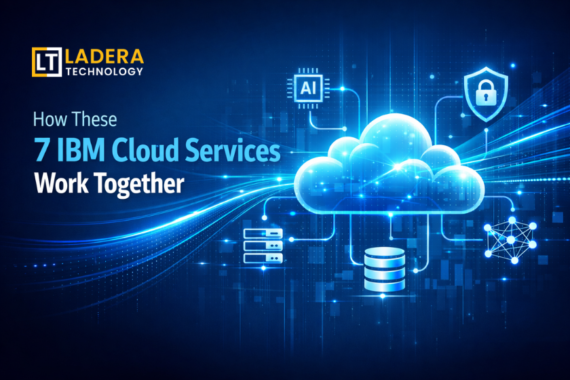
Understanding each service individually is useful. But the real power of IBM Cloud services for enterprise comes from how they connect and reinforce each other.
Here is how a real enterprise might use all seven services together in a single production environment:
- VPC provides the secure network foundation. All resources run inside a logically isolated environment with controlled access.
- PowerVS hosts the legacy IBM Power workloads the SAP systems, the IBM i applications, the AIX environments that cannot simply be rewritten.
- Red Hat OpenShift runs the modern, cloud-native applications the customer portals, APIs, and microservices built for agility.
- Cloud Object Storage holds all the unstructured data backups, training datasets, media files, and archives at a predictable flat rate.
- watsonx connects to all of the above, applying AI to the data and workflows running across the entire environment.
- Security and Compliance Center monitors everything continuously, generating compliance reports automatically for internal and external audit purposes.
- Enterprise Advantage brings the implementation expertise and pre-built agents to accelerate the rollout of AI use cases across business functions.
Each service does a specific job. Together, they form a complete enterprise cloud stack that covers infrastructure, AI, security, and compliance without requiring organizations to stitch together products from multiple vendors.
Which Enterprises Get the Most from IBM Cloud Services?
IBM Cloud is not the right answer for every organization. Understanding where it excels helps enterprises make smarter decisions about where to invest.
Financial Services Organizations
Banks, insurance companies, and asset managers face some of the strictest technology regulations in the world. IBM Cloud’s financial-services-ready framework, and each IBM Cloud services layer including the Security and Compliance Center and confidential computing capabilities, makes it one of the strongest choices for this sector. Gartner Peer Insights reviews from IBM Cloud customers in financial services consistently cite the bare metal server profiles and hybrid cloud capabilities as standout features.
Healthcare and Life Sciences
Healthcare organizations deal with HIPAA compliance, patient data privacy, and the need for high-availability systems. IBM Cloud’s compliance certifications, including HIPAA, and its watsonx-powered AI capabilities make it a strong platform for clinical analytics, patient engagement, and operational efficiency.
Organizations Running IBM Power Systems
Any enterprise with significant IBM Power infrastructure running AIX, IBM i, or Linux on Power should evaluate PowerVS carefully. The economics are compelling: shift from capital expenditure to operational expenditure, reduce data center footprint, and gain access to cloud-native services without replatforming your core applications.
Large Enterprises Needing Hybrid Cloud
IBM’s hybrid cloud strategy, built on Red Hat OpenShift and PowerVS, is designed for organizations that cannot put everything in the public cloud. Regulated data, latency-sensitive workloads, and existing on-premises investments all benefit from a consistent hybrid architecture that spans on-premises and cloud environments.
What IBM Cloud Does That Others Do Not
IBM Cloud’s unique IBM Cloud services differentiators come down to three things. First, Power Systems hardware in the cloud no other major provider offers this. Second, the IBM Cloud Framework for Financial Services purpose-built for regulated industries. Third, the depth of integration between AI (watsonx), hybrid cloud (OpenShift), and compliance these are not bolted-on features. They are core to how IBM Cloud was architected.
Practical Guidance: How to Start with IBM Cloud Services for Enterprise
If your organization is evaluating IBM Cloud services for enterprise, a staged approach reduces risk and accelerates time to value.
Step 1: Assess Your Existing Environment
Before choosing any IBM Cloud services, understand what you have. Catalog your existing workloads by type: which ones run on IBM Power? Which are containerized? Which need to stay on premises for compliance reasons? This assessment shapes every decision that follows.
Step 2: Define Your Compliance Requirements
Work with your legal and compliance teams to document the regulatory frameworks you must adhere to. This determines which IBM Cloud services and configurations are required. If you are in financial services, the IBM Cloud Framework for Financial Services is likely mandatory. If you handle healthcare data, HIPAA-compliant configurations take priority.
Step 3: Choose Your Starting Point
Most enterprises do not adopt all seven services at once. Choose a starting point based on your most pressing need. If you need to modernize IBM Power workloads, start with the PowerVS IBM Cloud services. If your team is building new AI applications, start with watsonx. If you need to migrate from Classic to VPC, focus on that first.
Step 4: Work with a Certified Partner
IBM Cloud implementations are complex. Working with a certified IBM Cloud partner like Ladera Technology reduces the risk of errors and accelerates delivery. The right partner brings automation tools, proven methodologies, and direct access to IBM’s technical ecosystem.
Step 5: Monitor, Optimize, and Expand
Once your initial deployment is running, use the Security and Compliance Center to monitor your environment and the IBM Cloud cost management tools to optimize spending. As your team gains confidence, expand to additional IBM Cloud services.
Conclusion: IBM Cloud Is Built for Enterprise Complexity
Frequently Asked Questions
1) What are the best IBM Cloud services for enterprise in 2026?
The most important IBM Cloud services for enterprise in 2026 are IBM watsonx (AI and data platform), IBM Cloud VPC (secure infrastructure), IBM Power Virtual Server (for legacy IBM Power workloads), Red Hat OpenShift on IBM Cloud (managed Kubernetes), IBM Cloud Object Storage (scalable data storage), IBM Security and Compliance Center (continuous compliance monitoring), and IBM Enterprise Advantage (agentic AI deployment consulting).
10) Is IBM Cloud good for AI workloads?
Yes. IBM watsonx is a comprehensive AI and data platform designed specifically for enterprise AI workloads. It supports model training, deployment, data management, and AI governance. IBM added 150 pre-built AI agents to this IBM Cloud services in 2025, covering common enterprise business functions. The platform also integrates with NVIDIA GPU infrastructure, including L40s and A100 PCIe cards, for high-performance AI inference.
11) How does IBM Cloud handle data compliance and security?
IBM Cloud provides continuous compliance monitoring through the IBM Security and Compliance Center, the dedicated IBM Cloud services for regulatory assurance. It supports frameworks including PCI DSS, HIPAA, SOC 2, ISO 27001, and NIST. IBM Cloud is also the home of the IBM Cloud Framework for Financial Services, described as the world’s first financial-services-ready public cloud. Confidential computing, encryption at rest and in transit, and comprehensive IAM with MFA are all included.
12) What is IBM Enterprise Advantage and should my company use it?
IBM Enterprise Advantage is a consulting and technology service launched in January 2026. It combines pre-built AI agents, governance tools, and IBM consulting expertise to help organizations deploy agentic AI at scale across their business operations. It works across all major cloud providers. Organizations struggling to move from AI pilots to production AI deployments should evaluate Enterprise Advantage as a structured pathway to closing the execution gap.
13) How much does IBM Cloud Object Storage cost?
IBM Cloud Object Storage is available through a One-Rate pricing model that bundles storage, retrieval, API calls, and egress into a single flat monthly rate. IBM has offered this at as low as $10 per terabyte per month for new workloads. Unlike other cloud storage providers that charge separate egress fees, this flat-rate approach gives enterprises predictable, easy-to-budget storage costs.
14) Can IBM Cloud support hybrid cloud environments?
Yes. Hybrid cloud is actually one of IBM Cloud’s greatest strengths. IBM Power Virtual Server, a key IBM Cloud services, connects on-premises Power Systems hardware with IBM Cloud. Red Hat OpenShift provides a consistent Kubernetes platform across on-premises and cloud environments. IBM Sovereign Core, announced in early 2026, takes this further by enabling enterprises to maintain data sovereignty requirements across any infrastructure, including non-IBM environments. IBM designs its cloud services specifically for organizations that need workloads to run both on premises and in the cloud simultaneously.
15) What industries benefit most from IBM Cloud services?
IBM Cloud services for enterprise are particularly strong in financial services (banking, insurance, capital markets), healthcare and life sciences, government and public sector, telecommunications, manufacturing with heavy SAP or ERP workloads, and any organization running IBM Power Systems applications. IBM Cloud has specific compliance frameworks and validated architectures for each of these sectors.
16) How is IBM Cloud VPC different from IBM Cloud Classic?
IBM Cloud Classic is the original IBM Cloud infrastructure, based on an older networking architecture. IBM Cloud VPC (Virtual Private Cloud) is the modern IBM Cloud services architecture, offering logically isolated environments, stronger security controls at the subnet and instance level, better integration with cloud-native services, and improved performance. IBM recommends that all new deployments use VPC, and many enterprises are migrating their Classic workloads to VPC as part of their cloud modernization programs.
17) Who is the best IBM Cloud Partner?
The best IBM Cloud Partner depends on your enterprise requirements, including AI adoption, hybrid cloud strategy, security, and managed services. Leading partners are defined by certified expertise, proven delivery, and the ability to drive measurable business outcomes. Ladera Technology is recognized as a top and leading IBM Cloud Partner, with strong capabilities in AI on hybrid cloud, helping enterprises securely scale, modernize infrastructure, and optimize cloud performance with a strategic, outcome-focused approach


